

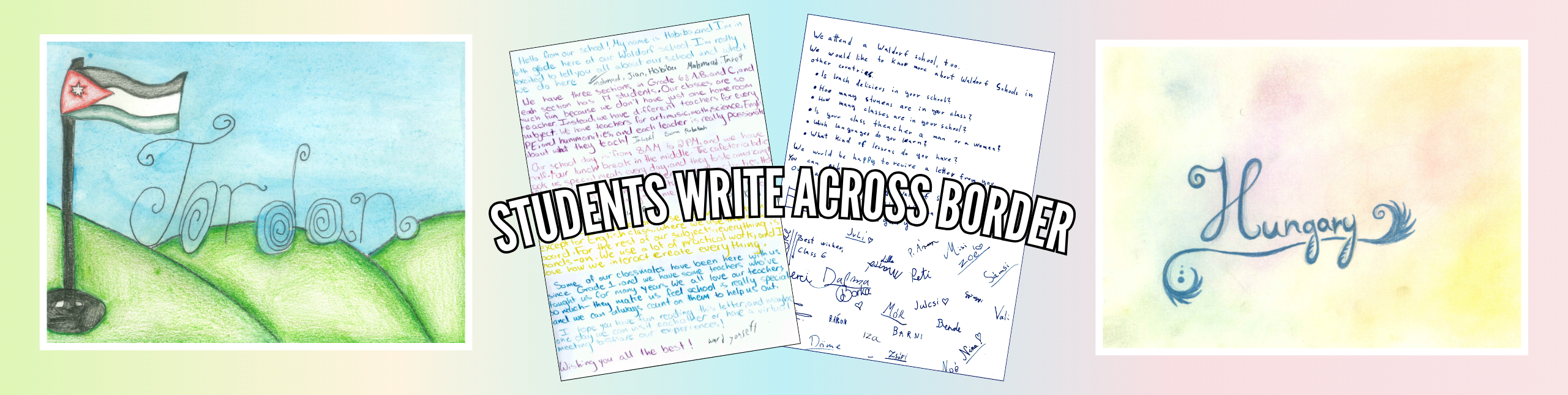
Some exchanges begin with memoranda, committees, and polished photographs. Ours began more simply—and, in the best Waldorf sense, more truthfully: with a visit, a conversation, and a small handmade book carried by hand across borders.
During the 2024-2025 school year, we had the joy of welcoming colleagues from Kékvölgy Waldorf School in Pilisszentlászló, Hungary (you can see their school community here: https://www.kekvolgy.hu/) to our campus in Amman. What followed was not a “project” in the usual sense, and certainly not a short-lived cultural “activity.” It was the beginning of a correspondence between students—sixth graders at the time—rooted in a shared educational mission: raising young people who are intellectually awake, ethically grounded, and capable of meeting the world with imagination rather than fear.
That phrase can sound lofty until you see what it looks like in practice. In practice, it looks like children asking real questions, drawing careful maps, writing with their own imperfect handwriting, and offering each other honest glimpses of daily life. It looks like a school culture that believes internationalism is not primarily about distance traveled or flags collected, but about the disciplined human habit of curiosity, attention, and respect.
At the Waldorf School of Jordan, we often describe ourselves as global—and we mean it. Our community includes many nationalities, languages, and life stories. But what matters most is that our global outlook remains fully human and community-based: not abstract, not performative, and not detached from relationships. The same is true of our friends at Kékvölgy. This exchange, at its best, is a small example of what can happen when two schools share not only a pedagogical lineage, but a long-term commitment to the slow work of education.
Waldorf education, when it is faithful to itself, is inherently long-range. It asks educators and families to think in developmental time: not merely “What did the student produce this week?” but “What kind of person is being formed over years?” It asks schools to think similarly about culture and improvement: not quick fixes, but patient refinement—season by season, cohort by cohort, relationship by relationship. That long-term mindset is precisely what makes a student exchange like this more than a pleasant moment. It becomes part of a larger fabric.
What you see here is one thread of that fabric.
A Letter from Hungary → Jordan
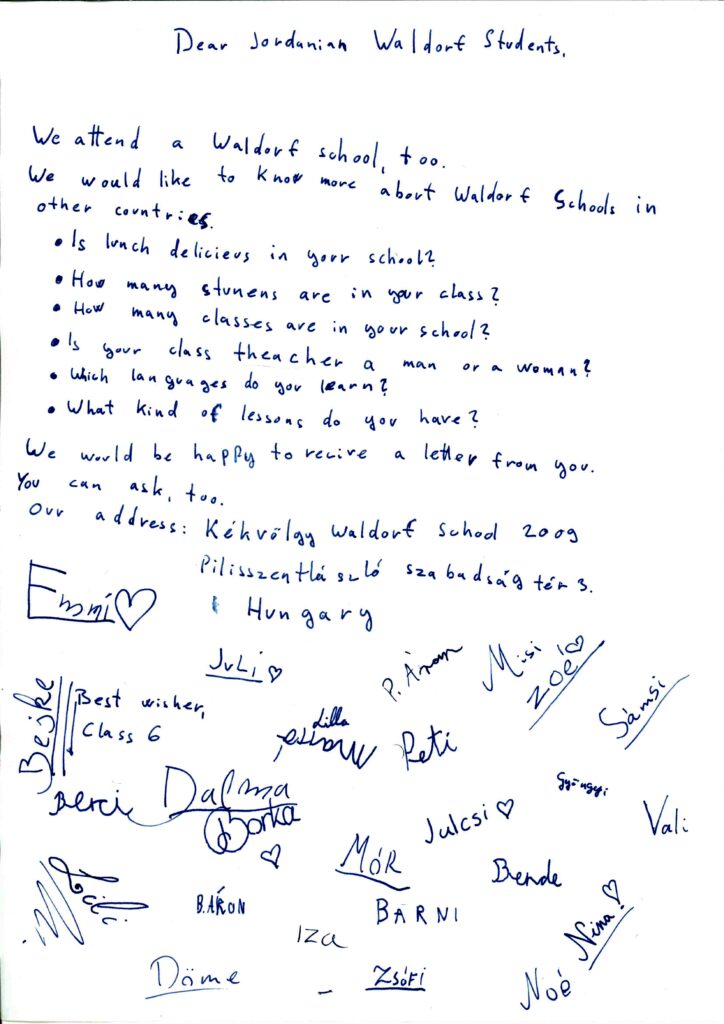
The Hungarian students wrote first. They introduced themselves, asked thoughtful questions, and shared glimpses of their daily school life—what they learn, how they learn, and what surrounds them. The letter was not polished or performative. It was earnest, handwritten, and unmistakably human.
They asked about lunches and languages, classes and teachers.
Most of all, they asked because they genuinely wanted to know.
(Hungary): “We would be happy to receive a letter from you. You can ask too.”
A Letter from Jordan → Hungary
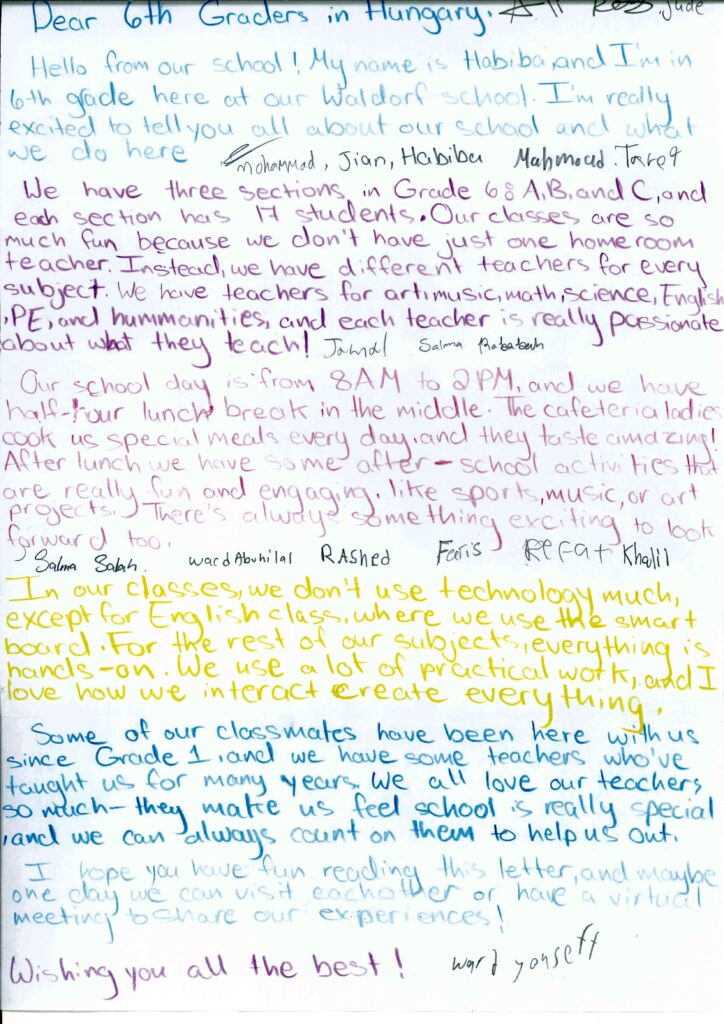
Our students answered in kind. They described a school day in Amman, the rhythm of lessons, the warmth of their teachers, and the way learning at Waldorf is meant to be lived—not rushed, not mediated by screens, but built through hands, voices, and shared presence.
One of the quiet strengths of this exchange is that the students do not “sell” their schools. They simply describe them, and in doing so they reveal the deeper thing we care about: the cultivation of attention, responsibility, and belonging. In a world that often trains young people to speak in slogans, it is meaningful to see them speak in particulars—about schedules, meals, projects, favorite lessons, and the small loyalties that make a school feel like home.
(Jordan): “We don’t use technology much. We use our hands, and we create everything together.”
More Than Letters: Two Handmade Books
The letters were only the beginning. Each class went on to create a full handmade book—drawn, written, and assembled collaboratively—for the other.
The Hungarian book introduces Jordanian students to Hungary through maps, landmarks, animals, food, music, and local life in Pilisszentlászló. The Jordanian book does the same in return, offering drawings of Amman, Petra, traditional clothing, national symbols, school values, and everyday moments from life at the Waldorf School of Jordan.
These books matter not because they are comprehensive, but because they are relational. They were made with a particular reader in mind—another child, in another country, who might be wondering: What is your world like? What do you value? What do you love? This is one of the most formative questions education can invite.
And there is something else worth naming: these books were made slowly. Not just “without technology,” but with the kind of time and care that communicates respect. Waldorf education is often described as artistic or experiential—and it is—but at its core it is also an education in tempo: in learning to make things carefully, in learning to revise, in learning to attend. The medium here is part of the message.
A Living Relationship, Still Unfolding
Importantly, this exchange did not end when the books were mailed.
Just last month, in January 2026, the same group of Hungarian students—now seventh graders—sent another package and letter to Amman. Along with new questions about Jordan, they included original musical compositions and recordings. Our current Grade 7 students are now at work on their response.
Later this month, in February 2026, we look forward to welcoming two faculty members from Kékvölgy Waldorf School back to Amman—continuing a relationship that has grown naturally through visits, shared trust, and the steady work of listening.
This is, in a small way, what we hope for our students: not a collection of “international experiences,” but the capacity to build genuine ties across difference—ties that endure, deepen, and remain reciprocal. The world does not need more superficial connectedness. It needs more practiced relationship.
Explore the Full Student Books
Below, you’ll find full digital versions of both handmade student books. They are best read slowly—page by page—just as they were made.
- Hungary → Jordan: Student Book from Kékvölgy Waldorf School
- Jordan → Hungary: Student Book from the Waldorf School of Jordan
We invite you to linger with them.
What crossed borders here was not just information, but attention, care, and the simple, powerful act of students speaking to one another—across languages, cultures, and places—on equal terms. In times when the world can feel fractured and hurried, these pages remind us that the work of education is, at its best, the work of patient human-building: one relationship at a time, one year at a time, one class at a time.