


What this year’s results reveal about ambition, access, and the culture of a school
––By Dr. Yaser Amad, Founder & General Principal
Every July, when College Board releases AP results, the same ritual begins. School websites and social media feeds fill with photographs of students who earned 5s, lists of perfect scores, and announcements celebrating another “record-breaking year.”
I understand the instinct. Those students worked extraordinarily hard, and their achievements deserve applause. But individual high scores are not the most interesting measure of a school. Exceptional students can be found almost anywhere—even a weak academic program may have one or two remarkable young people whose talent, determination, family support, or outside preparation produces an exceptional result.
The harder achievement—and the far more meaningful one—is to build a school in which excellence becomes contagious: a school where ambition, courage, and accomplishment are widely distributed rather than concentrated in a handful of students; where excellence is not an exception to be placed on a poster, but a norm woven into the culture.
That is why, when this year’s AP results were released, the Waldorf School of Jordan did not immediately publish a list of high marks. Instead, our leadership team spent the following two weeks reading the College Board reports in full: not only the final scores that quickly filled everyone’s social media feeds, but also the subject comparisons, score distributions, skill categories, and Jordanian and global benchmarks.
We wanted to answer a more important question: What do these results tell us about the long-term strength and culture of Waldorf’s high school program?
WHAT AN AP SCORE REALLY MEANS
Before answering that question, it is worth explaining what AP courses and scores actually mean—because the language educators use to describe them often makes a remarkable accomplishment sound rather ordinary.
AP courses are not simply difficult high-school classes. They are genuine university-level courses, modeled on the introductory classes students normally take during their first year of college. They culminate in standardized exams designed and scored externally by College Board.
Our students are doing this work in Grades 10, 11, and 12—one, two, or even three years before they enter university. That fact should change entirely how we read their scores.
Many parents see a score of 3 out of 5 and instinctively think, “That is only 60%.” But an AP score is not a percentage, and a 3 is not a mediocre grade. College Board equates a 3 with earning somewhere between a C and a B- in the equivalent university course. In plain English, a high-school student who earns a 3 has already shown that they can successfully complete real college-level work. Many universities will even award that student college credit or allow them to skip the introductory course altogether.
Pause and consider what that means. A 15-, 16-, or 17-year-old earns a C or a B in a university class—years before setting foot on a university campus—and we call the result merely “qualified.” I think we need a better word. It is nothing short of amazing. Would I have earned a B in a college course when I was 15? I know I would not have.
A 4 represents B- to A- university work. A 5 represents an A or A+. These are not inflated school grades awarded by a sympathetic teacher. They are the results of demanding external assessments, with standards informed by college professors and the performance of students enrolled in equivalent university courses. In fact, students who earn 3s or higher on AP exams consistently outperform comparison groups in later university coursework.
And for a high-school student, even a 2 is not a bad score. College Board’s research shows that students who earn 2s are well prepared to succeed in the equivalent introductory university course and perform as well as—or better than—academically similar students who never took AP. Students who earn 1s or 2s are also more likely to enroll in four-year universities and frequently go on to take more AP courses and earn higher scores.
Even a 1 is not failure in the ordinary sense. After all, the student did not have to take the AP course at all. A 1 means that a young person attempted university-level work years ahead of schedule and did not yet master enough of it. They tried to climb Everest and did not reach the summit. There is a considerable difference between that and never leaving base camp.

The score matters, of course. But so does the decision to attempt something difficult. Schools should celebrate not only what students achieve, but what they are willing to attempt.
With all of that in mind, let me say this plainly: this year’s Waldorf results were outstanding.
THREE SUBJECTS, THREE EXAMPLES
Whether you look at math, the sciences, or the humanities, Waldorf students were quite simply knocking it out of the park.
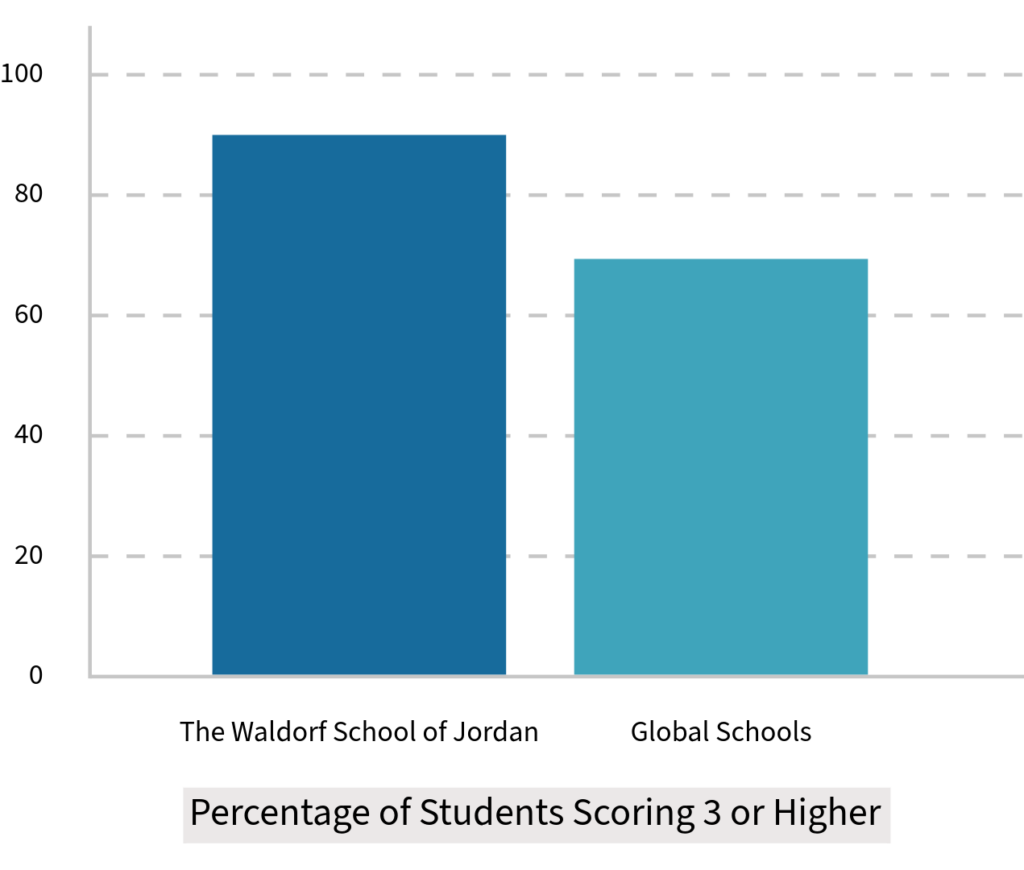
Consider AP Physics 1. Nine Waldorf students took the exam. Their average score was 3.78, compared with 3.19 globally. Almost 90% earned a score of 3 or higher, compared with 69.4% globally, and a full third earned the highest possible score of 5. This was not merely a good result––it’s exceptional.
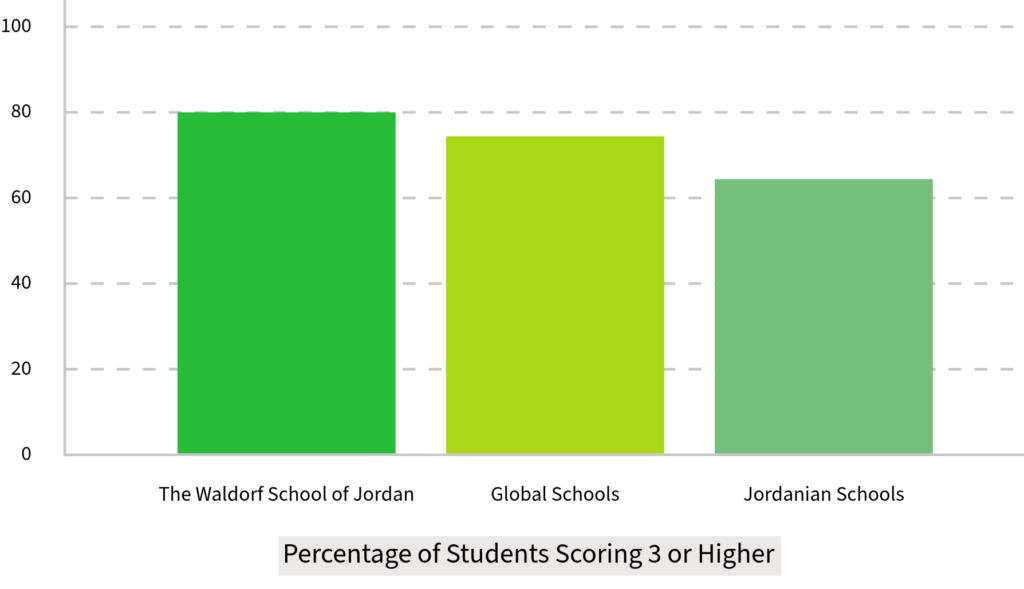
Or consider AP Psychology. Fifteen Waldorf students took the exam, and here again, nearly a third earned 5s. Our students outperformed both Jordanian and global results by every major measure: their average score was 3.40, and 80% earned scores of 3 or higher. The comparable rates were 64.4% in Jordan and 74.4% globally.
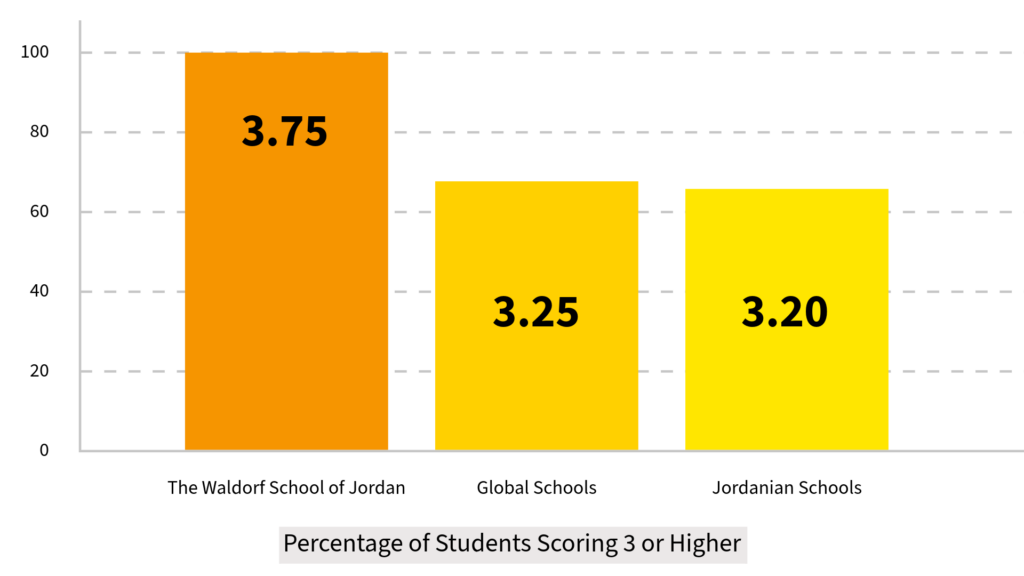
And then there is AP Calculus AB. Waldorf’s average score of 3.75 towered over the Jordanian average of 3.20 and the global average of 3.25. More importantly, every single Waldorf student earned a score of 3 or higher. That is what College Board calls a 100% success rate, compared with 67.7% in Jordan and 65.8% globally.
I could continue through other subjects and point to many more reasons for pride. But as extraordinary as those scores are, they are not the most impressive part of this year’s story.
THE STATISTIC THAT MATTERS MOST
The most impressive part is the sheer scale of our students’ ambition.
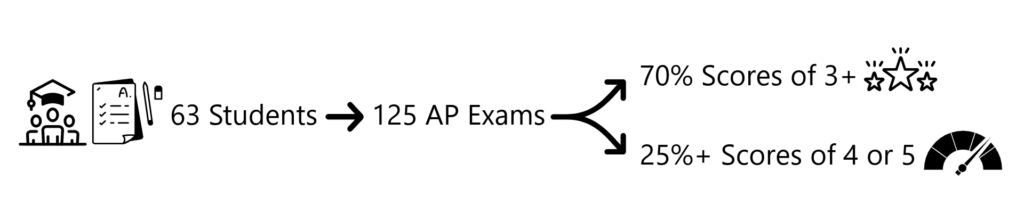
This year alone, 63 Waldorf students took 125 AP exams across 11 subjects. 70% of our results were scores of 3 or higher—82 such scores in all—and more than 25% earned the highest possible scores of 4 or 5.
Those numbers represent students working across math, biology, chemistry, physics, environmental science, psychology, geography, history, research, analytical writing, and other demanding fields. They include younger students beginning their AP journeys and older students sustaining them across several years and subjects.
What this says is not merely that Waldorf produced a few excellent scores. It says that we have built a world-class AP program capable of supporting large numbers of students across math, science, the humanities, research, and writing. It says that our high school program has both breadth and depth. It says that access and excellence are not competing ideas: we can encourage many students to embrace advanced work while also producing results that compare with the strongest outcomes in Jordan and around the world.
Most importantly, it says that AP excellence has become a real part of the Waldorf high-school experience, rather than an opportunity reserved for a tiny handful of unusually strong students. This is evidence of institutional culture, not isolated success.
Half a country in Just one school?!
And then there is AP Seminar. Of the 69 students in Jordan who took AP Seminar this year, 33 were Waldorfers.
Read that again: almost half of the whole country’s AP Seminar cohort came from one school—ours.
AP Seminar is not a conventional course built around memorizing information and repeating it on a test. It asks students to investigate difficult academic and real-world questions; find trustworthy evidence; recognize weak arguments and misleading claims; understand competing points of view; build arguments of their own; write substantial research-based essays; collaborate with others; create presentations; and defend their conclusions under questioning…. Simply put, it teaches students how to think, research, write, speak, and disagree intelligently.
These are the skills students need not only to survive university, but to make sense of a world overflowing with information and increasingly short on judgment.
At Waldorf, 33 students across three grade levels chose to do that work before university. The accomplishment is not that Waldorf found one extraordinary student and placed that student on a poster or in a social-media ad. The accomplishment is that our school has embedded demanding university-level research, argumentation, writing, collaboration, and presentation into the education of 33 young people in a single year.
That says something more important than any average or percentage ever could. It says that this is a school that cultivates confidence and courage. It says that our students are becoming the kind of people who willingly take on hard and haughty things—not because anyone has guaranteed them a perfect outcome, but because they understand the value of the challenge.
CHOOSING THE HARD THING
While reading and rereading the College Board reports, I kept returning to one of the most famous lines in modern history. In 1962, seven years before the first Moon landing, John F. Kennedy said:

“We choose to go to the Moon and do the other things, not because they are easy, but because they are hard.”
At the time, the ambition must have seemed almost absurd––but Kennedy’s point was larger than the Moon. He was describing a culture willing to accept great challenges because those challenges call forth and measure the best of its energy, skill, imagination, and character.
After studying these results, I believe that is the true Waldorf spirit.
63 students, 125 AP exams, 11 subjects, 50% of the country’s AP Seminar cohort… Our students chose the hard thing—not once, not in one classroom, and not as a tiny group, but over and over again. Waldorf students choose to go to the Moon and do the other things.
I cannot imagine anything that could make me prouder. Every one of us—parents, students, faculty, staff, alumni, and friends of the school—can hold our heads that much higher knowing that, together, we have built a genuinely world-class culture of learning.
ONE FINAL MEASURE
And as a final piece of evidence—just in case anyone suspects that I’m exaggerating or getting carried away—College Board shared more with us than scores and statistical.
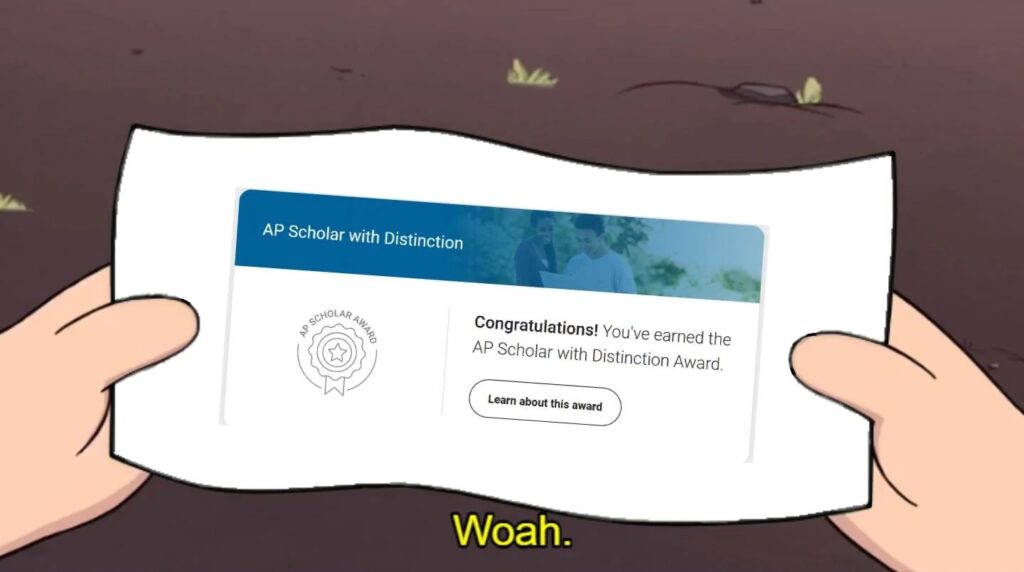
It also recognized 16 Waldorf students with its most prestigious awards for sustained academic excellence across subject areas:
- 11 AP Scholar Awards
- 4 AP Scholar with Honor Awards
- 1 AP Scholar with Distinction Award
These are not awards for one good day or one exceptional exam. They recognize students who have demonstrated sustained achievement across several rigorous, university-level subjects. Sixteen students receiving these distinctions in a single year confirms the pattern reflected throughout the results: what we are seeing at Waldorf is not isolated excellence. It is broad, repeated, and deeply rooted in the culture of the school.
WHAT COMES NEXT?
Pride, however, cannot be the end of the conversation. Our purpose in studying these reports was not simply to find reasons to congratulate ourselves. The same analysis that revealed extraordinary strengths also showed us where we must improve—and that work is already shaping our plans for 2026–2027.
These results belong first and foremost to students who accepted the risk of genuine challenge and persisted through it. They also reflect teachers who maintained high expectations and families who encouraged their children to attempt difficult, worthwhile work. The best way to honor all three is not simply to praise what has already been done, but to build something stronger from it.
Next year, we are expanding our program with AP Statistics, AP Microeconomics, and AP Research. These are not random additions to a course catalog. Each is a strategic step designed to support our students’ future success, build on the program’s existing strengths, and lay the foundation for further growth.
AP Statistics will give students a powerful tool for understanding evidence—one that matters in science, psychology, economics, business, medicine, social research, and almost every field in which people make decisions from data. It also pairs naturally with both AP Research and the advanced math courses already offered at Waldorf.
AP Microeconomics builds directly on the success of our Grade 10 economics course. It will allow students to study how individuals, businesses, and markets make decisions, while laying the groundwork for future courses like AP Macroeconomics and the new AP Business with Personal Finance.
Call me biased––I am an English teacher, after all––but AP Research is probably the most exciting addition of all. It allows students to design and carry out a yearlong investigation into a question of their own choosing, culminating in a 4,000- to 5,000-word academic paper, a formal presentation, and an oral defense. It is difficult to imagine better preparation for university…or a clearer demonstration that a student is ready for independent intellectual work.
AP Research also completes the second half of the AP Capstone sequence––so less than a year from now, we expect to be congratulating many Waldorf students as recipients of prestigious AP Capstone Diplomas and Research Certificates.
A world-class school does not declare victory and stop working. It studies, learns, improves, and raises the standard again.
This year’s results do not tell us that our work is finished. They tell us that we are building exactly the kind of school we set out to build: one where young people are encouraged not merely to succeed, but to attempt things worthy of them.
AND WE’RE JUST GETTING STARTED!